


‘La Bola Negra’ Review: A Rousing Testament to Queer Love's Timeless Resilience
‘La Bola Negra’ Review: A Rousing, Uneven Queer Odyssey
Skip to content
Skip to content
Menu CloseNewsletters
Subscribe
Sign In
Search The Wrap
Search
Main
- TV
TV News Ratings Streaming Media News * Reviews
- Movies
Movie News Box Office Reviews Sundance Cannes Venice Film Festival * Toronto Film Festival
- Awards
Awards Tracker Awards Coverage Oscars Emmys How I Did It Series TheWrap Emmy Magazines * TheWrap Oscar Magazines
- Industry
AI Deals & M&A Data Analysis Earnings Coverage Streaming Charts Tech Trade Secrets The Grill * Game On: A Wrap Sports Series
- Columns
WaxWord Steve Pond The Media Front Inside the Ratings * Creatorverse
- WrapStyle
Fashion Culture TheWrapBook Vol. 5: The Art of Cinema 2025 TheWrapBook Vol. 4: The Art of Television 2025 TheWrapBook Vol. 3: The Art of Cinema TheWrapBook Vol. 2: The Art of Television 2024 * TheWrapBook Vol. 1: The Art of Cinema
- Events
Events Calendar The Grill Power Women Summit Screenings Series * Screenings RSVP
- Topics
Politics Music Theater Labor & Unions Podcasts Sports
- Multimedia
Videos Photos
- What to Watch
- Newsletters
Subscribe
Follow Us
- Visit The Wrap on facebook
- Visit The Wrap on twitter
- Visit The Wrap on instagram
- Visit The Wrap on youtube
Top Categories
- TV
- Movies
- Awards
- WrapPRO
- WrapStyle
- What to Watch
- Columns
- AI & Tech
- Business
- Media
- Video
Home>Creative Content>Movies
‘La Bola Negra’ Review: A Rousing Testament to Queer Love’s Timeless Resilience
Cannes 2026: Javier Calvo and Javier Ambrossi deliver a decades-spanning odyssey unlike anything you’ve seen
Zachary Lee
May 21, 2026 @ 5:59 PM
Share on Social Media
- Share on Facebook
- Share on X (formerly Twitter)
- Share on LinkedIn
- Share on Email
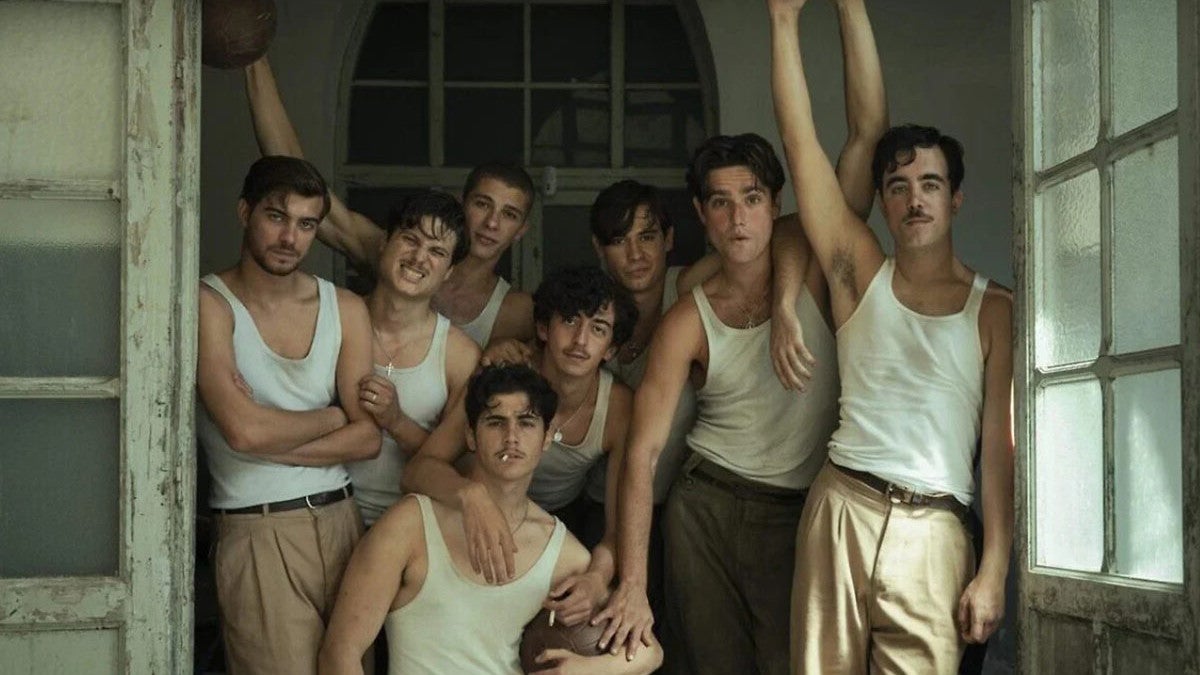
"La Bola Negra" ("The Black Ball") (Cannes Film Festival)
It’s only in the cinema where the impossible can be made possible, and with filmmakers Javier Calvo and Javier Ambrossi’s “La Bola Negra (The Black Ball),” the past and present break free from the constraints of linearity, transforming into lovers who flirt and fight with each other. From the directing duo known as Los Javis’ rattling opening to its devastating coda, it’s one of those rare films that feels both old and new.
It’s rife with ingenious and technical marvels and sequences that rank among cinema’s best while also telling a very classical story about honoring those who’ve come before us, making space for the stories of those we may never meet, and acting as a celebration of those who never gave up on their love even when it was punishable by death.
Take the opening sequence, set in 1937, where a village housing musician Sebastián (Guitarricadelafuente) sees his entire family and community get slaughtered by aerial gunfire. His escape sequence immediately tips viewers off that the epic that unfolds for the next two and a half hours is in the hands of filmmakers who know how to imbue their spectacle with heart.
Sebastián climbs through the bodies of the dead before coming face to face with a felled sculpture that’s been pierced with arrows. He uses the arrows the way some might use rocks when bouldering, as a way to give his hands a grip to climb out of the hell around him. That the sculpture, porcelain white and shaped in the way the idols to the Greek gods might be, is a clever touch; Sebastián, with his dark skin, Adonis features, and bloodied body, is eschewing that worldview in exchange for telling a new story we haven’t seen before. What we see is nothing short of witnessing a new mythology being created before your very eyes.
[](https://www.thewrap.com/creative-content/movies/cannes-victorian-psycho-reviews-maika-monroe/)
Read Next
Cannes Day 10: ‘Victorian Psycho’ Shocks, ‘Iron Boy’ Finds a Home
Sebastián was loyal to Nationalist Italian rebels, hence their punishment from the government, and against his will, he’s forced to join the fascist army that caused his village’s massacre. While there, he meets leftist prisoner, Rafael (Miguel Bernardeau), whom he’s to befriend so that Rafael might give up sensitive information. It’s evident, though, that Rafael has a role in Sebastián’s own queer awakening. This adds another layer to Sebastián’s deception, as he’s trying to hide his own blossoming feelings, his marching orders, and his own hatred for the regime he’s serving under.
…